Green Kalasatama
The Healthy Liveable Neighborhoods pilot programme is part of the Nordic Healthy Cities project. The three agile pilots selected for the programme were carried out in three Nordic district innovation labs: Helsinki and Vantaa in Finland and Stavanger in Norway. The themes of the pilot programme included green infrastructure, urban farmingn, food services and logistics. The pilots were carried out in summer and autumn 2021. Also involved in the collaboration were the cities of Kristiansand in Norway and Copenhagen in Denmark.
The aim of the Green Kalasatama pilot project was to test how an augmented reality (AR) application could be used to help the residents of an area under development commit to and learn about the design of green spaces. Residents used a mobile application to see what a planned green space would look like and were also able to use the virtual view to add trees, bushes and other plants to their desired locations. Created by Granlund, the AR application allowed city planners to provide information to residents about the benefits of green construction and visualise different greenscapes in the real environment.
The pilot was carried out in Sompasaari, one of the neighbourhoods of Kalasatama, which is located by the sea and is very densely built. The pupils of the local school and the area’s residents were invited to discover the future of the built area with the help of the Green Kalasatama application and share their thoughts on what the planned green space should look like.
The feedback from the users was positive, as well as the interest from the district’s urban planners seeking innovative ways for user participation. In the future, the use of such data remains to be explored more in detail after the early phase pilot. There is more to learn as the technologies develop and users’ own devices become more advanced. The digital means of engagement remain central tools to hear the residents’ voice in Helsinki’s Innovation Districts.
Contact information:
Francisco Forns-Samso
Digitalization Manager
Granlund Oy
Parkly: smart and modular urban furniture
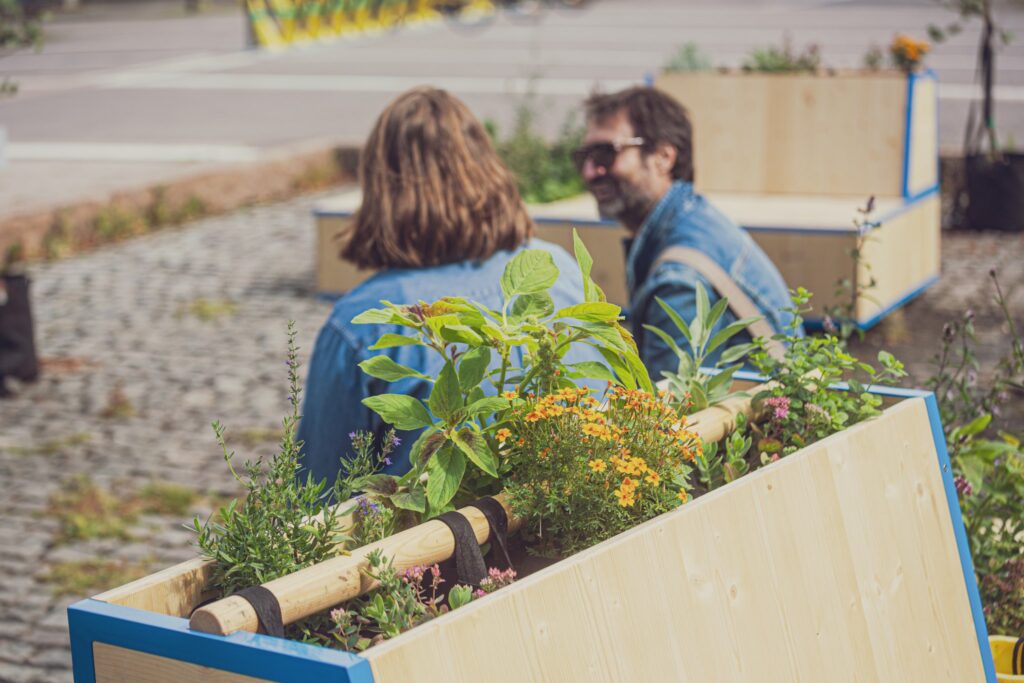
The Helsinki Innovation Districts project collaborates with companies and residents to test and develop new services that contribute to the pleasantness, functionality and sustainability of urban living. One of the new services that has already been tested in Helsinki’s suburban regeneration areas is urban green oases and verdant hangout spots. Parkly’s smart and modular urban furniture were piloted in summer 2021 on Ylä-Malmi square and Kalasatama.
Developed by urban design agency RaivioBumann, the purpose of Parkly is to increase the amount of urban greenery in both public spaces and yards with the help of movable green urban furniture modules. The modules are used to grow various herbs and edible and pollinator-friendly plants. The urban green oases built out of them can also be used to manage stormwater and alleviate urban heat islands on a small scale. In Kalasatama, Parkly modules also served as platforms for sensor solutions for monitoring the state and microclimate of green spaces. In the future, AR & 3D-based co-creation application will allow residents to take part in implementing their own Parkly solution.
“What makes Parkly so versatile is the movability and modular nature of the green units. The units can be customised and combined in many ways to flexibly build different solutions for a variety of environments, such as asphalt streets or paved market plazas. Parkly is more about creating a place than furnishing a space,” says designer Päivi Raivio.
Ecological and made from wood, Parkly modules are a rapid response to people’s wishes to see more greenery in various urban spaces where adding it would be otherwise difficult. They are also a part of the circular economy, as the trees growing in the Parkly modules will end up being planted in parks, for example, once they have grown to a certain size.
Parkly green modules were positively received by residents in the pilots. The Parkly assembly in Malmi was designed in collaboration with daycare children, local young people and other residents. The Parkly green oasis also served as a venue for small events and contributed to the revitalisation of market events in Malmi. For the City, the pilot provided valuable information on what kind of functions the marketplace currently has and how the space is used. Furthermore, the pilot also provided insight on how the place could be developed in the future. “The purpose of these kinds of pilots is to find new solutions for Helsinki. In this pilot, we wanted to test how movable green solutions work as meeting places and how they contribute to the pleasantness of sites awaiting redevelopment,” says the Helsinki Innovation Districts project’s Project Manager Maija Bergström.
More information
Innogreen’s green stops
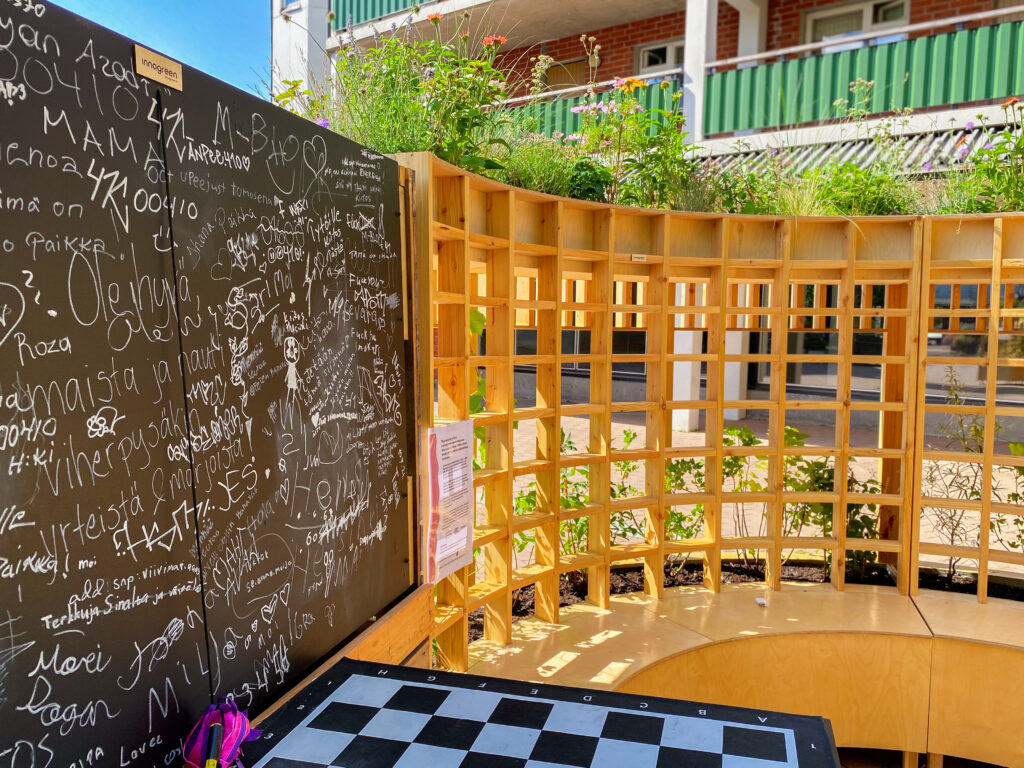
The Helsinki Innovation Districts project collaborates with companies and residents to test new services that contribute to the pleasantness, functionality and sustainability of urban living. Green stops and modular green hangout spots are new services that help to not only increase the pleasantness of the urban environment in a sustainable manner, but also support improving the living conditions of pollinators and managing stormwater and heat islands in the suburban regeneration areas of Helsinki.
Back in the Smart Kalasatama project, Innogreen built one of the first outdoor green walls suitable for Nordic conditions in Kalasatama’s school yeard. In the subsequent Helsinki Innovation Districts project, Innogreen piloted modular green stops in Malminkartano.
Innogreen’s stylish green stops feature a low-carbon, arched wooden design that can be adapted for a variety of uses and spaces. The green stops function as both resting and hangout spots for residents and as green structures. They have plants for pollinating insects at the top of the structure and a variety of edible plants at the bottom, which even include shiitake mushrooms.
The green stops can also be connected to an irrigation system powered by solar panels. In addition to this, they can be outfitted with various sensors for collecting valuable data on the environment and its well-being, for example.
Innogreen’s green stops were actively visited by residents in Malminkartano, who also recognised their possibilities, including their benefits to insects. The green stops also garnered praise for their appearance. Innogreen’s green stops are one of the responses to requests for more green walls and roofs, which have been expressed by many Helsinki residents, serving as a quick, yet sustainable solution to this need.
Many of the area’s residents were concerned that the green stops would end up being destroyed or vandalised. Yet despite these fears, the stops remained undisturbed for the duration of the season. Their maintenance was handled by Innogreen.“Residents made the stops their own and took care of them. Many found it fun to observe the insects on them, for example. A number of residents also submitted ideas for further development,” says Mikko Sonninen from Innogreen.
Photos: Innogreen
Example sites help envision wood construction
The district of Mellunkylä includes areas of Vesala, Kontula, Kivikko, Mellunmäki and Kurkimäki. In the Helsinki Innovation Districts the possibilities and challenges of wood construction are being explored by using four example sites from Mellunkylä. These are: a future residential area of “Wood-Kivikko” envisioned between the Kivikko park area and Kontula centre; Mellunkylä Avenue located between the Kontula and Mellunmäki metro stations; the southern part of Länsimäentie; and Kontulankaari. These example sites will help elaborate what kind of solutions could work in different parts of Mellunkylä.
In Mellunkylä, the majority of urban infill will be carried out on existing plots. Urban infill can also be an opportunity for housing companies to finance extensive renovations by tapping into their permitted building volume. The urban infill can include repair, demolition and supplementary construction. Carbon neutral urban infill could be carried out in the form of new wooden buildings or wood-structured additional floors to existing blocks of flats, for example.
“It is important to increase both contractors’ and housing companies’ interest towards carbon neutral urban infill while looking for appealing, cost-effective and feasible solutions in collaboration with residents. We want to encourage companies to develop carbon neutral solutions for a variety of residential areas,” says Project Coordinator Petra Turtiainen from Forum Virium Helsinki.
Developing new wood construction solutions with design sprints
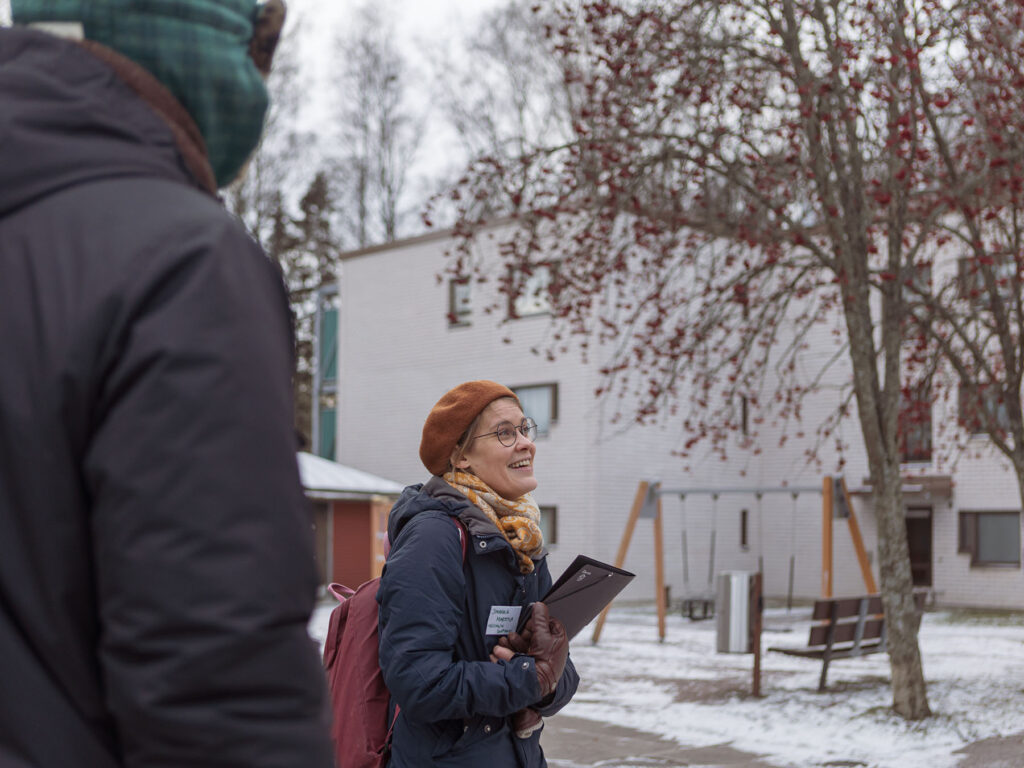
The development of carbon neutral wood construction was promoted with a set of three different design sprints, each lasting for two days. The participants included experts from various fields who are interested in wood construction and the Mellunkylä area, from architects to house manufacturers and from developers to urban renewal and urban development experts. Design sprint is a product development method originally developed by Google that Forum Virium Helsinki has adopted to infrastructure projects..
The topics of the three design sprints were the possibilities and challenges of innovative wood construction, cost-effective and high-quality wooden blocks of flats and services for sustainable and carbon neutral living.
The purpose of the design sprints was to help produce ideas for the development of ecologically sustainable and innovative suburban areas. The aim is to increase shared understanding for the purpose of increasing wood construction and building dialogue with companies in the sector. The invited participants were given the task of developing cost-effective and feasible solutions, from carbon neutral area development concepts to wooden house concepts and a model library of standard residential blocks.
The solutions and ideas developed in the workshops can also be utilised in other developing areas in the Helsinki region and the rest of Finland.